


Every year, thousands of taxpayers across Houston — from The Heights and Cypress to Katy and Northwest Houston — trust someone else to prepare and file their federal tax return. But here’s a question many individuals and small business owners rarely ask:
Is your tax preparer legally authorized to file your return with the IRS?
If the answer is unclear, your 2026 refund could be at risk.
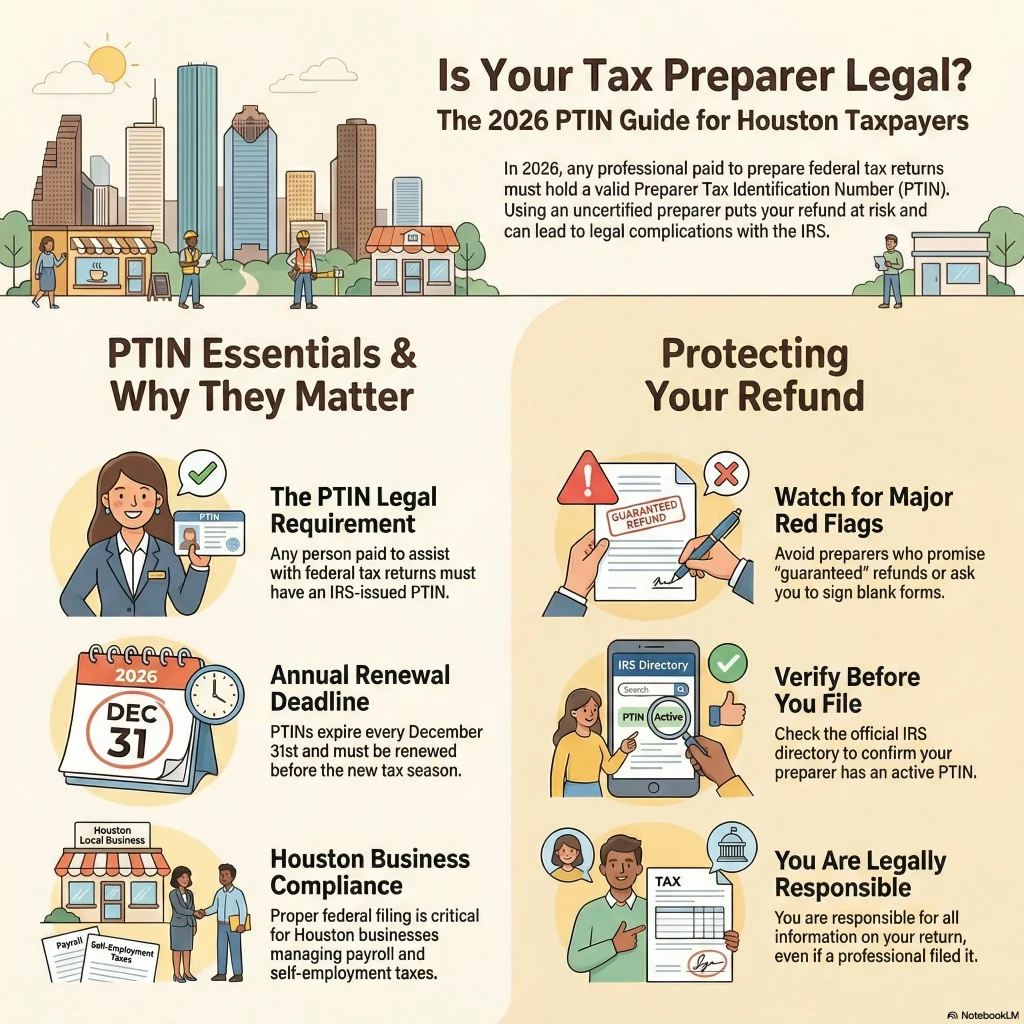
For Houston families, self-employed professionals, and small-to-mid-size businesses, one of the most important (and most overlooked) requirements is whether the preparer has an active PTIN.
Let’s break down what that means and how you can protect yourself.

A Preparer Tax Identification Number (PTIN) is required by the Internal Revenue Service (IRS) for anyone who prepares or assists in preparing federal tax returns for compensation.
If someone charges you to prepare your federal income tax return, they must:
PTINs expire every year on December 31 and must be renewed before filing returns for the new tax season.
If a preparer’s PTIN is expired or missing, they are not legally allowed to prepare and sign federal tax returns.
For Houston taxpayers navigating federal filings, self-employment taxes, or Texas-based business reporting requirements, this is not a minor technicality — it is a legal compliance issue.
Texas does not have a state income tax, but that does not mean business compliance is simple.
Small businesses in Houston must still manage:
If your tax preparer cuts corners at the federal level, it can trigger broader financial and compliance issues that affect your entire operation.
That’s especially true for startups and growing companies that rely on accurate reporting to secure business financing, maintain clean books, and scale properly.
Many taxpayers assume the risk falls only on the preparer. Unfortunately, that’s not always how it works.
If your preparer is not compliant:
Remember: You are legally responsible for the information on your tax return — even if someone else prepares it.
For Houston entrepreneurs, that can mean delayed refunds, disrupted cash flow, and unnecessary stress during peak business cycles.

If you’re evaluating a tax professional this season, here are warning signs you should never ignore:
Every paid preparer must include their PTIN on the return. If it’s missing, that’s a serious compliance issue.
Never sign a blank or incomplete tax return. A reputable professional will review everything with you before filing.
No legitimate tax professional can guarantee a specific refund amount without reviewing your full financial situation.
Aggressive refund promises are often linked to inflated credits, improper deductions, or risky filing strategies.
The IRS maintains an official online directory where taxpayers can verify certain credentials and qualifications of tax preparers.
Before handing over your Social Security number or sensitive business documents, take a few minutes to:
This simple step can prevent major financial and legal problems later.

At SAS Tax & Business Solutions, we work with individuals, startups, contractors, and established businesses throughout the Greater Houston area.
Our approach goes beyond seasonal tax filing. We focus on year-round compliance, financial clarity, and strategic growth.
Depending on your needs, we offer:
As a BBB Accredited Business headquartered at 5700 NW Central Dr, Unit 110, Houston, TX 77092, we prioritize:
When your preparer is properly credentialed and supported by structured internal processes, your risk drops significantly.
Tax season moves fast. Once a return is filed incorrectly, fixing it can be stressful, time-consuming, and expensive.
Before trusting someone with your refund or your company’s financial data:
If you’re unsure whether your current preparer meets IRS requirements — or if you want a second opinion before filing — we’re here to help.
Ready to simplify your finances and protect your refund?
Call SAS Tax & Business Solutions at (832) 263-7308 or email [email protected] to schedule your consultation today.
A PTIN (Preparer Tax Identification Number) is required for anyone who prepares or assists in preparing federal tax returns for compensation. If someone charges you to file your taxes, they must have a valid and active PTIN issued by the IRS.
Yes. PTINs expire on December 31 each year and must be renewed before the preparer files returns for the new tax season. An expired PTIN means the preparer is not legally authorized to file federal tax returns.
You may not be penalized simply because the preparer failed to comply, but you are legally responsible for the accuracy of your tax return. If errors, inflated credits, or improper deductions are filed under your name, you could face delays, audits, or repayment obligations.
You can ask your preparer directly for their PTIN and verify their credentials through the official IRS directory of federal tax return preparers. Always confirm before signing or filing.
No. A PTIN allows someone to legally prepare federal tax returns for compensation, but it does not automatically mean they are a CPA, Enrolled Agent, or attorney. Higher credentials may provide additional representation rights before the IRS.
Business owners handle more complex filings, including payroll, self-employment taxes, and potential Texas Franchise Tax obligations. Filing errors can affect cash flow, financing opportunities, and long-term business growth. Working with a credentialed, compliance-focused firm reduces that risk significantly.